 ClayTrace
Measure shrinkage with a test bar
Use the clay you actually work with, prepared the way you usually prepare it, and fire the bar with your normal glaze firing. A number from a bag or a data sheet is a starting point; your kiln, cone and atmosphere decide the result you live with.
- Roll a slab and cut a bar a little longer than 10 cm (or 4 in).
- While the clay is still soft, press two marks exactly 10 cm (or 4 in) apart. Write the clay and date on the bar.
- Let it dry slowly and completely, then bisque and fire it with your glaze load.
- Measure the distance between the marks as precisely as you can.
- Shrinkage % = (marked length − fired length) ÷ marked length × 100.
An example
Marks 10 cm apart that measure 8.7 cm after the glaze firing give (10 − 8.7) ÷ 10 × 100 = 13% total shrinkage. Digitalfire describes about 14 to 15% total for a porcelain as close to the most a potter should normally meet, so a number far above that is worth re-measuring.
Measuring the bar after drying as well splits the total into drying and firing shrinkage. That helps when you switch clays or kilns, but for sizing a piece the total, wet to fired, is the number you need.
Work out the size to make
Divide the finished size you want by (1 − shrinkage). For a 4-inch-tall mug in a clay that shrinks 12%, make it 4 ÷ 0.88 = 4.55 in tall.
A common slip is to add the percentage instead: 4 in plus 12% is 4.48 in, which fires to about 3.94 in. The gap grows with bigger pieces and with clays that shrink more.
| Finished size | At 10% | At 12% | At 14% |
|---|---|---|---|
| 4 in | 4.44 in | 4.55 in | 4.65 in |
| 8 in | 8.89 in | 9.09 in | 9.30 in |
| 10 cm | 11.1 cm | 11.4 cm | 11.6 cm |
| 25 cm | 27.8 cm | 28.4 cm | 29.1 cm |
Why a real piece can differ from the bar
A flat bar shrinks freely. A thrown or handbuilt piece may shrink by different amounts in height and width, and a wide base can drag on the shelf. When you measure matters too: a pot measured at leather hard has already done part of its drying shrinkage, so its rate looks smaller than one measured freshly formed.
Keep measuring real pieces. Note the clay, the condition the piece was in when you measured (freshly formed, leather hard or bone dry), the cone, and the length, width and height before and after firing. After a few pieces in the same clay you have a rate for each direction that matches how you make things.
Sources and further reading
Plan sizes from your own pieces with ClayTrace
Record before- and after-firing dimensions on any piece, with the condition you measured it in, for free. Studio Pro shows the measured shrinkage for each piece, lists earlier pieces in the same clay body as references, and gives you two calculators: Estimate final size and Plan from a target size. Planned sizes are never saved as measurements.
Free pottery journal · iPhone and Android · No account
See how ClayTrace works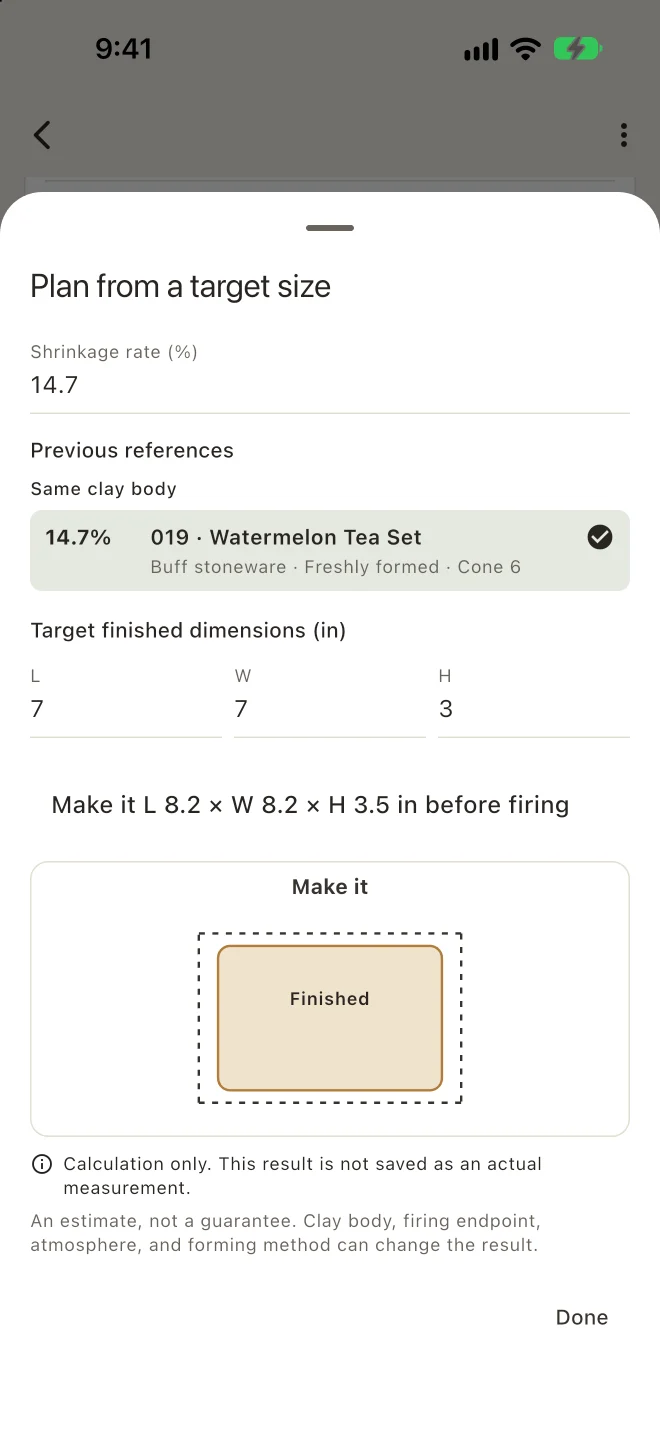
Questions
Does clay shrink the same amount in every direction?
Not always. Forming method, wall thickness and drag on the kiln shelf can make height and width shrink differently. Measure each direction on real pieces if the size matters.
Should I measure when the piece is wet or leather hard?
Either works if you are consistent and note which one you used. A rate measured from leather hard leaves out the shrinkage that happened before, so use it only for pieces you also measure at leather hard.